The Pilates Teaching Roadmap: From Beginner to Expert
May 20, 2026
Many Pilates instructors feel stuck in their teaching without fully understanding why.
You may be taking continuing education workshops, learning new exercises, and collecting cueing ideas — yet still feel unsure how to create lasting client transformation or build long-term confidence in your teaching.
The truth is that great teaching is not about knowing the most exercises.
It comes from developing a specific set of teaching skills over time.
In this article, we’ll look at four essential teaching competencies every Pilates instructor needs to develop, along with a simple framework to help you identify where you currently are and what to focus on next.
The 4 Core Teaching Skills
Strong Pilates teaching is built on four key areas:
-
Workout Planning
-
Cueing
-
Movement Assessment
-
Mindset
Each skill is broken down into three levels. As you improve in one area, your teaching becomes clearer, more effective, and more impactful for your clients.
Read through each category and identify which level best describes your current teaching.
Workout Planning
Workout planning is more than choosing good exercises.
It’s the ability to create sessions that feel intentional, progressive, and appropriate for the client in front of you.
Planning Level 1: You Follow a Clear Structure
At this level, you have a reliable framework for building classes or sessions.
You are no longer copying other people's class flows, improvising randomly or relying entirely on Instagram for inspiration. Your sessions have flow, consistency, and organization.
This stage is important because structure creates confidence — both for the teacher and the client.
Signs You’re Here:
-
You use a repeatable class structure
-
You understand how to sequence exercises
-
Your sessions feel more organized than reactive
Planning Level 2: You Choose Exercises Based on Goals and Needs
At this stage, programming becomes more individualized.
Instead of simply choosing exercises you like or remember, you begin selecting movements based on:
-
client goals
-
client limitations or compensation patterns
-
progression or regression needs
You understand why you are choosing each exercise.
Signs You’re Here:
-
You can modify classes for different clients
-
You understand regressions and progressions for each exercise you teach
-
You can adapt your plan during a session when needed
Planning Level 3: You Create Long-Term Programs With Confidence
At this level, you are thinking beyond individual sessions.
You understand how to:
-
build progression over weeks and months
-
document client progress
-
know how to set goals with and for your clients
-
create purposeful long-term development
Your clients feel like they are on a journey rather than simply attending isolated workouts.
Signs You’re Here:
-
You track client progress
-
You build programs progressively over time
-
You can clearly explain why clients are doing what they are doing
Cueing
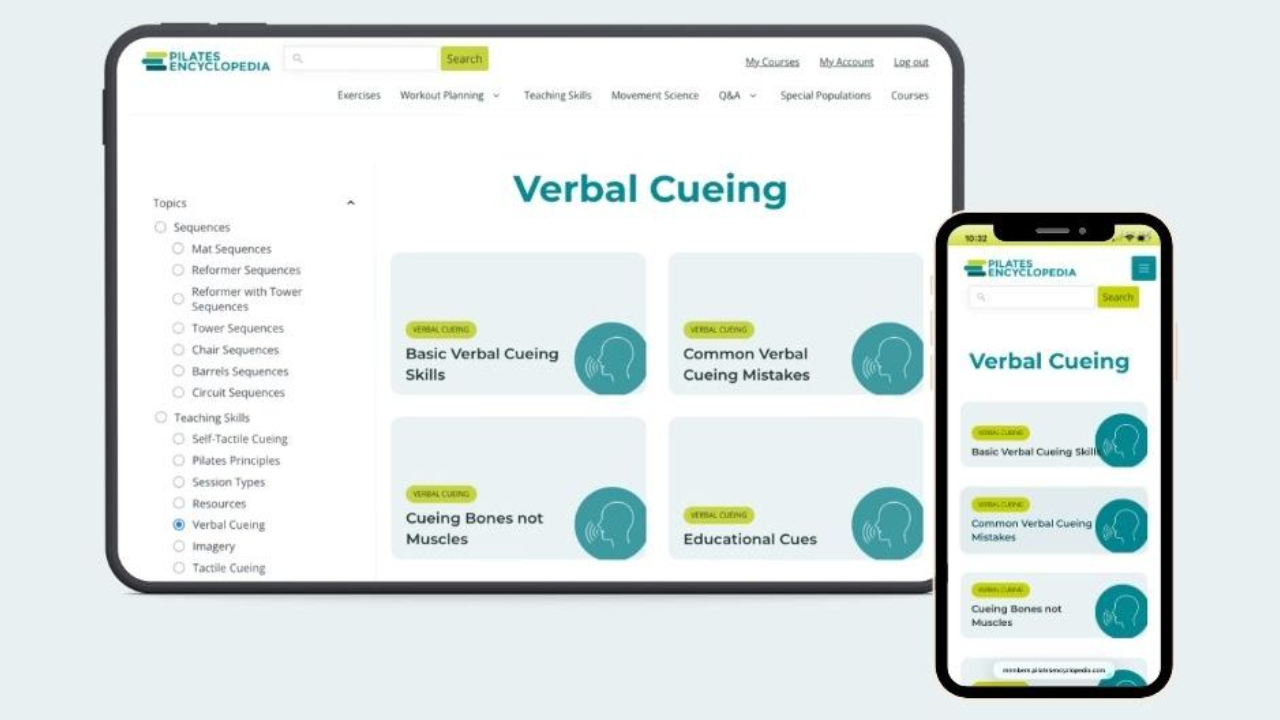
Cueing is one of the most visible teaching skills, but great cueing is about much more than using creative language.
Effective cueing creates understanding, awareness, and independence.
Cueing Level 1: Clients Can Follow Without Watching You
At this stage, your communication is clear enough that clients do not need to constantly look at you for guidance.
Your instructions are organized and understandable.
Signs You’re Here:
-
You give clear setup instructions
-
Clients can follow the flow of class
-
You use concise, direct language
Cuing Level 2: Clients Make Precise Changes From Your Cues
At this level, your cueing begins to create meaningful movement changes.
Clients are not simply following directions — they are improving movement quality because of your guidance.
Signs You’re Here:
-
Clients visibly improve after your cues
-
You can adapt your language for different learners
-
Your cues become more specific and intentional
Cueing Level 3: Clients Self-Correct With Minimal Prompting
This is where teaching becomes truly transformative.
Your cueing has developed enough precision and consistency that clients begin recognizing and correcting patterns on their own.
You are helping clients build body awareness rather than dependence on constant correction.
Signs You’re Here:
-
Clients notice and adjust their own habits
-
You use fewer words while getting better results
-
Clients move with more confidence and ownership
Movement Assessment
Movement assessment is what allows you to teach the person in front of you rather than simply teaching exercises.
It helps you make better decisions, provide better modifications, and create safer, more effective sessions.
Movement Assessment Level 1: You Understand Basic Movement Skills
At this stage, you understand:
-
movement skills and how load affects them
-
alignment and movement principles
-
foundational biomechanics
You can recognize that different bodies respond differently to movement demands.
Signs You’re Here:
-
You understand common compensations and how to correct them
-
You notice when exercises are too easy or too difficult
-
You begin observing movement quality more carefully
Movement Assessment Level 2: You Adapt Exercises Based on What You See
At this level, observation begins influencing your programming and cueing decisions in real time.
You can interpret movement patterns and adjust accordingly.
Signs You’re Here:
-
You confidently modify exercises and get better results from the student
-
You recognize when and why a client needs a different exercise or cue
-
You can simplify or progress exercises appropriately
Movement Assessment Level 3: You Have a System for Assessing and Improving Your Clients' Movement
At this stage, assessment becomes systematic rather than reactive.
You understand how to:
-
identify priorities (what to correct first and what can or should wait)
-
create strategies and set benchmarks towards future goals
-
assess your clients' movement accurately and reassess to notice objective progress
-
guide long-term improvement
Your teaching becomes fully intentional and individualized.
Signs You’re Here:
-
You notice movement patterns quickly
-
You have clear methods for addressing limitations
-
Clients experience measurable progress over time
Mindset
Teaching skill is not only technical. Your clients' mindset might be the most limiting factor in their progress. Mindset is all about communicating what client's can and cannot expect from their Pilates training.
Your ability to communicate the method's purpose and your intention, and your ability to build trust and rapport with your clients strongly influence whether they stay and continue progressing.
Mindset Level 1: Clients Enjoy Your Sessions but Retention Is Inconsistent
At this stage, clients may enjoy classes but often stop after a few months.
This is common early in a teaching career and usually reflects a need for stronger systems, confidence, and long-term vision.
Signs You’re Here:
-
Clients come and go frequently
-
You sometimes question your effectiveness
-
You rely heavily on motivation or personality
Mindset Level 2: Clients Stay for a Year or More
At this level, clients begin experiencing consistent value from your teaching.
They trust your process and feel supported in their progress.
Signs You’re Here:
-
Clients return consistently
-
You build stronger teacher-client relationships
-
Clients refer others to you
Mindset Level 3: Clients Stay for Years
Long-term retention is often a reflection of deep trust, strong results, and thoughtful teaching progression.
Clients feel seen, challenged appropriately, and supported over time.
Signs You’re Here:
-
Clients view Pilates as part of their lifestyle
-
You have strong long-term relationships
-
Your teaching creates loyalty and consistency
How to Progress Effectively
One of the biggest mistakes instructors make is trying to master one category while neglecting the others.
For example:
-
exceptional cueing cannot compensate for weak planning
-
strong planning (masterful flows) cannot replace poor communication
-
movement knowledge alone does not guarantee client retention
Balanced development matters.
Instead of trying to reach Level 3 in one category immediately, focus first on becoming consistently confident at Level 1 across all four areas.
Then work on Level 2 in one category at a time, then gradually build toward Level 3 over time.
This creates a more sustainable and complete teaching foundation.
Progress Takes Practice
Reading about teaching is valuable.
But improvement happens through implementation.
Teaching skills develop:
-
over time
-
through repetition
-
through observation
-
through reflection
-
through working with real people
The instructors who grow the most are usually the ones who consistently apply what they learn rather than endlessly consuming information.
Want Support Applying This Framework?
Inside the Pilates Encyclopedia membership, you get access to our Pilates Teacher's roadmap, which includes articles and lectures for each category and level and you can work through these skills independently with consistency and practice. Start Your Roadmap by Joining Today.
If you’d like a guided approach andmore support applying these concepts to real teaching situations, the Own the Room Bootcamp was designed specifically for Pilates instructors who want to become more confident, effective, and impactful teachers.
Inside the bootcamp, we break down all four teaching categories in depth and guide you through the progression from foundational skills to advanced application.
The goal is not just to help you learn more information — it’s to help you become the kind of teacher clients trust, return to, and grow with for years.