Inside Pilates Encyclopedia 3.0: How To Deepen Your Understanding of Pilates Exercises
May 12, 2026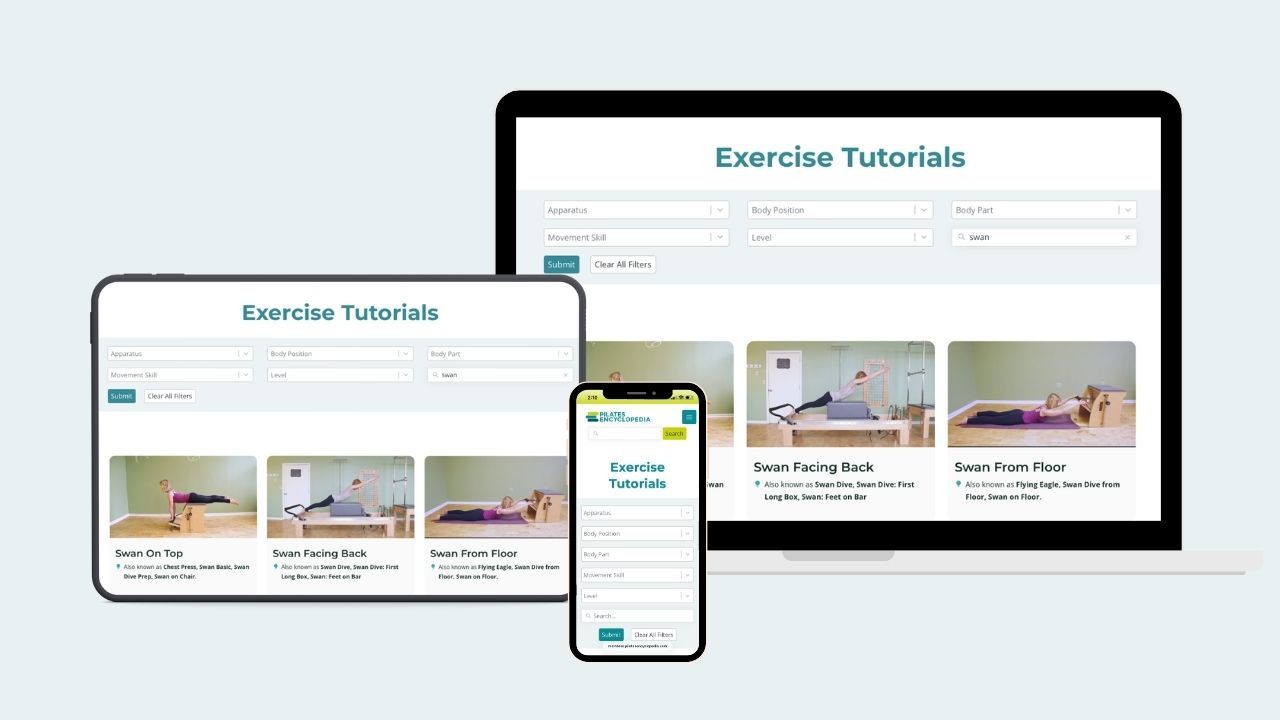
When most teachers look up a Pilates exercise tutorial, they find the same thing: a short description, a few setup cues, maybe a breathing pattern, and a handful of corrections. That’s where most teacher training manuals stop.
Pilates Encyclopedia was built to go far beyond that.
Inside PE, we don’t just give you the surface-level version of an exercise. We break down every single detail — from setup, biomechanics, muscular focus, transitions, teaching objectives, common mistakes, verbal and tactile cues, regressions, progressions, contraindications, programming ideas, and nuanced teaching strategies that only come from years of real-world experience.
The goal is simple: if you have a question about teaching an exercise, you should be able to find the answer inside the library.
This level of depth is what separates PE from everything else out there. Most resources give you enough information to recognize an exercise. We give you enough information to truly teach it with confidence.
And if you still need help? Every exercise tutorial includes a comment section where you can ask questions directly. We respond to comments daily, so you’re never left figuring things out alone.
In this post, we want to show you what that depth actually looks like by taking you inside one example tutorial from the library.
Before you jump in:
Pilates Encyclopedia is not for teachers who are just looking for a quick cue, a trendy exercise variation, or something flashy they can copy into tomorrow’s class. There are plenty of places online to collect random ideas. PE is for teachers who want to think more deeply about movement and truly understand what they are teaching. We focus on developing reasoning, clarity, and teaching mastery — not just memorization. The goal is not simply to know what to teach, but to understand why you are teaching it, how to adapt it, and how to teach it with confidence in real-world situations.
All right. Without further ado...
Here is another example:
Baby Swan
Also known as Prone Press Up, Swan Prep, or Prone Prep.
This is a regression of the full Swan, and prepares thoracic extension, which is probably one of the most difficult movement skills to “get”. Many of us have lost our awareness and connection to our thoracic spine.
Exercise Breakdown
Starting Position
- Lie on your stomach, in a prone position.
- Place your hands next to your shoulders with your elbows pointing back.
- Your legs are extended back and hip-width apart.
Movement Pattern
- INHALE, reach your chest forward, arching at your bra strap line.
- EXHALE, relax down.
- Repeat.
Analysis
- Brings awareness to the thoracic spine.
- Your thoracic spine extends against gravity.
- Strengthens your spinal extensor muscles (erector spinae).
- Your upper extremities are in a closed chain environment.
- Your abdominals have to work eccentrically, which means they have to lengthen while being engaged. It’s not relaxing and it’s not concentrically contracting (as in shortening), either. Eccentric abdominal activation in prone positions is difficult, at first.
Movement Skills
- Thoracic Spine Extension
Caution
Contraindications
- Spinal stenosis, spondylolisthesis | Practice Quadruped Swan instead.
Precautions
- Hernia | It may be more difficult to maintain transversus abdominis connection against gravity.
- Scheuermann’s disease | Have your client lie on a Reformer box, barrel or BOSU so that her spine can start from her neutral. Encourage elongation and a small range of motion with focused activation in the thoracic spine.
Alignment Points
Lower Extremities
- Press the tops of your feet firmly into the mat.
- Spread your toes and press all ten toenails into the mat.
- Keep your legs hip-distance apart and neutral in the hip sockets. Neutral rotation helps release the grip of the buttocks.
- Roll your inner thighs up and outer thighs down. This helps to keep a neutral rotation of the femurs.
- Place a block between your ankles to help with neutral rotation. (Follow the link under Related Repertoire).
Trunk + Pelvis
- Keep your pelvis neutral on the sagittal plane.
- Your hip bones and pubis are pressing evenly into the mat.
- Brush your buttock flesh to your heels (this activates your hamstrings).
- Lengthen your tailbone through your heels.
- Lift your frontal hip bones (ASIS) away from your thighs.
- Firm your lower abdominal wall.
- Imagine a rubber band between your hip bones (ASIS). Pull it taut.
- Lengthen your sacrum away from your shoulders.
- Lengthen the sides of your torso equally from your hips to your armpits.
- Reach your chest forward.
- Spread your collarbones wide.
- Allow your front ribs to separate like a fan. (Demonstrate by fanning your fingers open).
- The top of your sternum reaches forward and up as the bottom of the sternum descends (two-way stretch).
- Melt your shoulders down as you lift your sternum up.
Upper Extremities
- Draw your shoulders away from your ears.
- Place your palms flat on the floor.
- Press all ten fingers and the heel of your hand equally into the mat.
- Look first down, then slightly forward as you arch your upper back.
- Keep equal width across the front and the back of your shoulder girdle.
- Send your elbows far back to your feet. This will help keep your shoulders away from your ears.
- Keep your elbows tucked tightly against your torso.
Common Mistakes
- Collapsing (hyperextending) the lumbar spine and pushing the belly into the mat. To correct this, keep your lower abdomen firm. Move much higher in your spine.
- Throwing the head back (hyperextending the cervical spine). This is often compensation for a stiff or weak thoracic spine. To correct this, keep your cervical spine long, and focus on moving at your shoulder blade area.
- Over tucking the pelvis (posterior pelvic tilt). This is often due to over correction of abdominal activation. To correct this, remember to keep your hip bones connected with the mat. Perform a much gentler, more subtle abdominal activation.
- Retracting the shoulder blades. Scapular retraction is a common compensation (and combined movement) of spine extension. To correct this, keep your upper back wide.
- Too much (and incorrect) abdominal activation resulting in thoracic flexion with lumbar extension. To correct this, remember that you now have to do the exact opposite of what you did in a supine position lifting the chest. Allow your front ribs to widen.
Modifications
Regressions
- Keep the range of motion very small, don’t lift very high.
- Slide your arms a bit in front of your shoulders.
- E or W-position of your arms. Slide your arms away from the body, so your elbows are approximately next to your shoulders. Keep your forearms on the mat.
- Sphinx: Slide your arms forward, lift your chest and hold this position. Allow your mid-back to soften and sink down like a hammock. The further you slide your arms forward, the gentler the curve.
Progressions
- Come up higher, allowing the extension to move down your spine while keeping eccentric abdominal activation.
- Slide your palms a bit behind your shoulders.
Cueing
Verbal Cueing + Imagery
- Move in the longest possible arc.
- Imagine there is a big beach ball on your back. Imagine wrapping your spine around it.
- Open your chest towards the front of the room.
- Show off a necklace (or tie, or tattoo).
- Draw a wide smile across your low belly, from one hip bone to the other (to activate your transversus abdominis).
- Imagine nudging a marble with your nose. Watch it roll away.
- Imagine a big smile across your collar bones.
Hands-On Cues
- Place three fingers on your student’s mid-back area and ask her to pivot around your fingers.
- Place your palm onto your student’s sacrum and press straight down, and slightly towards her feet. This anchors and stabilizes the pelvis in neutral, avoiding over correction by tucking.
Workout Planning
Prepare For This Exercise With
- MAT Dart
- REFORMER Swan Facing Front
- SPINE CORRECTOR Seated Back Bend
This Exercise Prepares You For
- MAT Swan
- MAT Double Leg Kicks
Related/Alternatives
- FOAM ROLLER Kneeling Back Bend
- LADDER BARREL Standing Back Bend
- SPINE CORRECTOR Chest Lift
- SPINE CORRECTOR Dart
- SPINE CORRECTOR Seated Back Bend
- SPINE CORRECTOR Seesaw
Included In These Sequences
- Mat Sequence #2
- Prone Tower Flow #1
All Swan Variations
- Swan | Deep Dive
- MAT Baby Swan
- MAT Swan
- MAT Swan Dive
- MAT Quadruped Swan
- BLOCKS Swan
- LARGE BALL Swan (Dart progression)
- SITTING BOX Swan with Long Box
- REFORMER Swan Facing Front
- REFORMER Swan Facing Back
- TOWER/TRAPEZE TABLE Swan
- CHAIR Swan From Floor
- CHAIR Swan on Top
- SPINE CORRECTOR Swan Dive
- LADDER BARREL Swan
- LADDER BARREL Standing Swan