Are You Breathing Correctly? How Pilates Breathwork Supports Movement and Core Control
Dec 05, 2015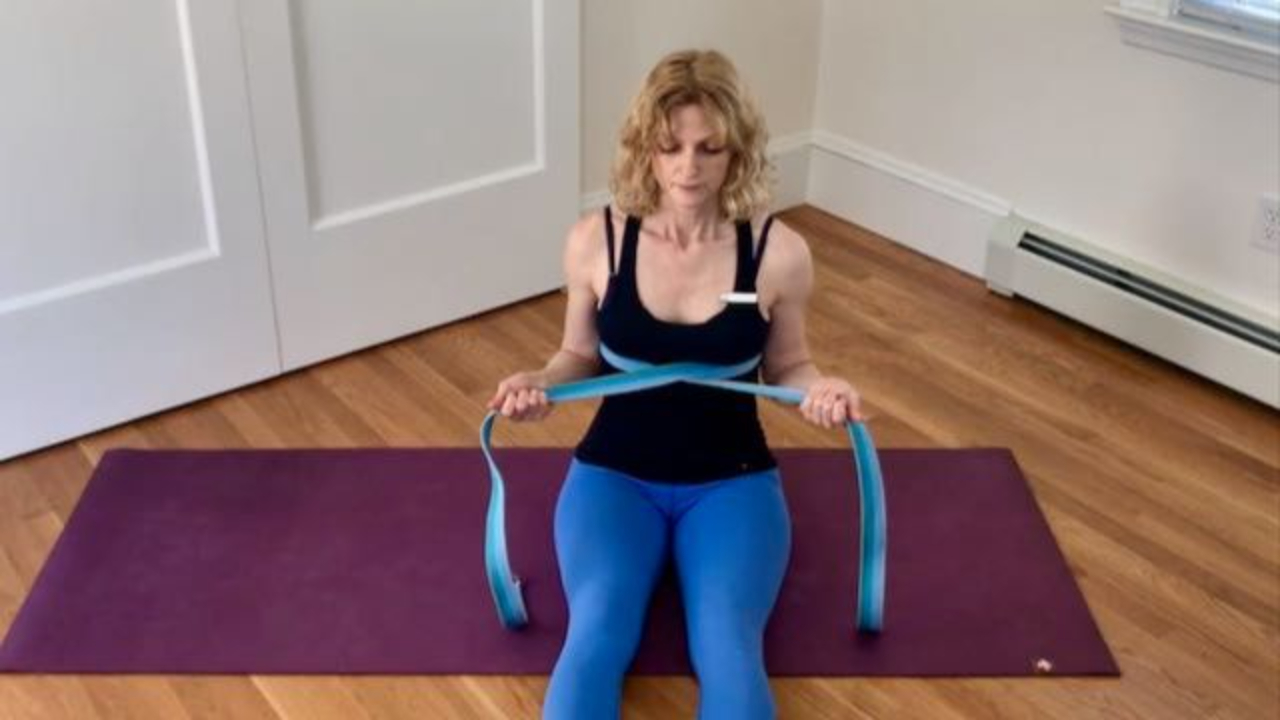
Have you ever wondered if there’s a “right” or “wrong” way to breathe in Pilates?
Breathing is something we do automatically all day long, but in Pilates, we bring conscious attention to it. That can sometimes make something completely natural suddenly feel surprisingly complicated.
Should you breathe into your belly? Your ribs? Your back? Your chest? Should you inhale during one part of an exercise and exhale during another?
The answer is: it depends.
There isn’t one single “correct” Pilates breath. Different breathing patterns can serve different purposes, and learning to access several of them can improve body awareness, movement, and your ability to coordinate the breath with the abdominal muscles and pelvic floor.
Joseph Pilates placed enormous importance on breathing. In Return to Life Through Contrology, he famously instructed us:
“Above all, learn how to breathe correctly.”
He viewed breathing as a way of cleansing and invigorating the body—bringing in fresh air and expelling stale air from the lungs.
Today, our understanding of breathing is more nuanced, but the underlying idea remains important: breathing is an integral part of movement.
Let’s look at three ways the rib cage and abdomen can move during breathing—and why each can be useful in Pilates.
First, What Actually Happens When We Breathe?
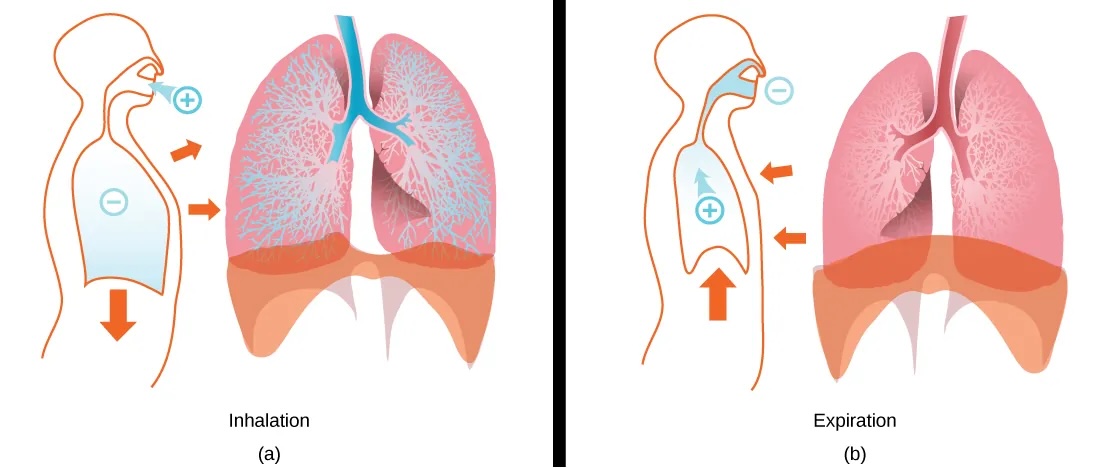
The diaphragm is our primary breathing muscle.
It is a dome-shaped muscle located underneath the lungs, separating the thoracic cavity from the abdominal cavity.
When you inhale, the diaphragm contracts and descends. At the same time, the rib cage can expand in several directions to create more space in the thorax. Air flows into the lungs.
When you exhale, the diaphragm relaxes and rises again as the lungs recoil and air moves out.
But breathing isn’t happening in just one place.
Ideally, the rib cage has the ability to expand three-dimensionally—to the front, sides, and back. The abdominal wall also responds to the movement of the diaphragm and changes in pressure inside the trunk.
That’s why it can be helpful to explore different breathing patterns rather than deciding that one particular type of breathing is always “correct.”
1. Diaphragmatic or Belly Breathing
If you practice meditation, relaxation techniques, or certain forms of yoga, you may already be familiar with what is commonly called belly breathing.
Belly breathing is often used to help people feel the movement of the diaphragm.
As you inhale and the diaphragm descends, the abdominal contents are displaced and the abdominal wall can gently expand. This creates the sensation of the belly rising or widening with the inhalation.
As you exhale, the abdominal wall can soften back toward its resting position.
This type of breathing can be particularly useful when the goal is relaxation, reducing unnecessary muscular tension, or simply reconnecting with a natural, easy breath.
Try it
- Lie on your back or sit comfortably and place one hand on your abdomen.
- Take a relaxed breath in and notice whether your abdomen gently expands into your hand.
- Exhale without forcing the belly inward.
- Rather than trying to make a huge movement, simply notice what happens.
- If your abdomen barely moves, experiment with allowing it to soften on the inhalation.
- The goal isn't to push the belly out. It's to give the breath room to move.
2. Bucket-Handle Breathing: Lateral Thoracic Breathing
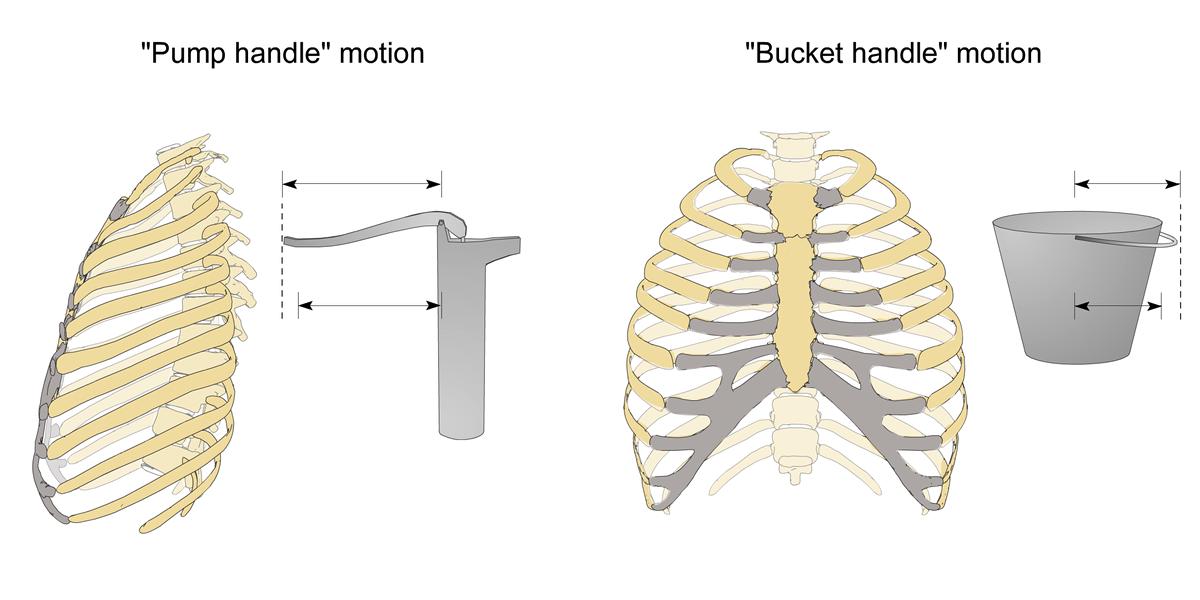
Another breathing pattern frequently emphasized in Pilates is lateral thoracic breathing, sometimes described as bucket-handle breathing, bellows breathing, or simply “breathing into the sides of the ribs.”
Imagine the handle of a bucket lifting outward.
As you inhale, the lower ribs can move upward and outward, increasing the width of the rib cage. As you exhale, the ribs move inward again.
This is particularly useful in Pilates because there are many exercises in which we want to maintain some abdominal support while still allowing a full, expansive breath.
Instead of thinking that you must choose between “using your abdominals” and “breathing,” lateral rib-cage expansion gives you another option.
Try it
- Wrap a yoga strap, belt, or towel around the lower part of your rib cage.
- Cross the ends in front of you and hold them comfortably.
- As you exhale, gently draw the strap snug around your ribs.
- Then inhale and feel your rib cage expand sideways into the strap.
- Can you feel the ribs widening?
- Now see whether you can also feel the back of the rib cage expanding.
- This is often an eye-opening experience. We tend to think of breathing as something that happens in the front of the body, but the ribs can move in the back and sides as well.
- You can also simply place your hands around the sides of your lower ribs and breathe into your hands.
3. Pump-Handle Breathing
We sometimes hear that “chest breathing” is bad.
But movement of the upper rib cage and sternum is a normal part of breathing.
The term pump-handle breathing describes the way certain ribs and the sternum move upward and forward during inhalation, somewhat like the handle of an old-fashioned water pump.
As you inhale, the front-to-back dimension of the rib cage can increase. As you exhale, the sternum and ribs return.
This movement matters.
If the upper rib cage is very rigid, breathing and movement options may become limited. Rather than trying to keep the chest completely still, we want the rib cage to be adaptable.
Try it
- Place one hand over the upper portion of your chest.
- Take a comfortable inhalation.
- Can you feel a subtle lifting or expansion underneath your hand?
- Then exhale and feel the sternum and ribs gently settle.
- If you don't notice much movement, don't force it. Keep breathing and direct your attention toward that area.
- Sometimes awareness alone begins to change the way we breathe.
Your Hands Are Powerful Teaching Tools
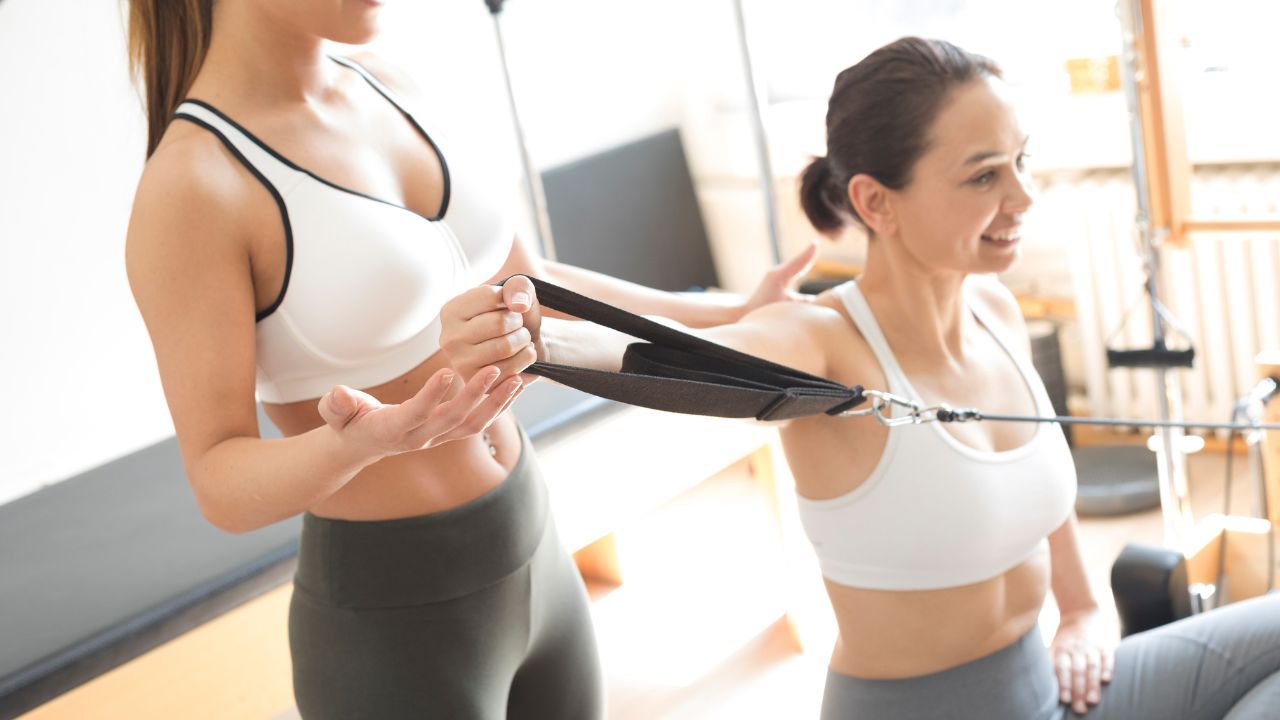
Placing your hands on the part of the body you want to explore can dramatically improve awareness.
This is one reason tactile cueing can be so effective in Pilates.
Touch provides additional sensory information. If you place your hands around your ribs, for example, it becomes much easier to notice whether the ribs are expanding—or whether one side moves differently from the other.
You can experiment with placing your hands:
- on your abdomen
- around the sides of your lower ribs
- on the back of the rib cage
- over the sternum or upper chest
Then notice where your breath naturally travels.
Instead of immediately trying to change your breathing, observe it first.
So Which Type of Breathing Is Correct?
This is where Pilates breathing gets interesting.
Dr. Brent Anderson, founder of Polestar Pilates, taught a guideline that beautifully summarizes the concept:
“Breath is a tool, not a rule.”
Rather than insisting that everyone breathe the same way during every exercise, consider what you are trying to accomplish.
Sometimes diaphragmatic breathing may be useful.
Sometimes you may want to encourage lateral expansion of the rib cage.
Sometimes you may want more movement through the sternum and upper ribs.
And sometimes the most important thing is simply to keep breathing while you move.
Work With the Breathing Pattern That Feels Limited
One useful approach is to explore the breathing pattern that is hardest for you.
If your belly expands easily but your rib cage feels rigid, spend some time practicing lateral and posterior rib breathing.
If you naturally breathe high into your chest, explore whether you can create more movement through the lower ribs, back ribs, and abdomen.
If your sternum barely moves, experiment with pump-handle breathing.
The goal isn't to replace one breathing pattern with another.
The goal is to develop options.
A body that can adapt its breathing to different positions, movements, and demands has more choices available to it.
And that idea fits beautifully with Pilates.
What Does Breathing Have to Do With Core Strength?
Quite a lot—but perhaps not in the way we sometimes think.
Your diaphragm, abdominal muscles, pelvic floor, and deep spinal muscles all contribute to the management of pressure and support within the trunk.
That means breathing and “core work” aren't two completely separate activities.
They have to cooperate.
When you inhale, the diaphragm descends and the trunk accommodates the change in pressure.
When you exhale, the abdominal wall can contribute more actively, particularly when an exercise requires greater trunk support.
This is one reason Pilates teachers often use an exhalation during the more demanding part of an exercise. The exhalation can help a student connect with abdominal support without holding the breath.
But this isn't an absolute rule either.
Different exercises—and different bodies—may benefit from different breathing strategies.
Breath Should Support the Exercise, Not Distract From It
As you become more familiar with Pilates exercises, you can begin asking a more useful question than:
“Am I breathing correctly?”
Instead ask:
“Is my breathing helping me do what I'm trying to do?”
For example:
- Does this breath help me organize my trunk?
- Can I maintain abdominal support without gripping or holding my breath?
- Can my ribs still expand while my abdominals are working?
- Does an exhalation make this movement easier to coordinate?
- Am I breathing freely, or have I become so focused on the exercise that I've stopped breathing altogether?
These questions turn breathing into a movement strategy rather than a rigid rule.
Two People May Breathe Differently—and Both May Be Right
This is one of the most important things to remember when teaching Pilates.
Two people can perform the same exercise next to each other and benefit from completely different breathing cues.
One person may need to learn how to expand the back of the rib cage.
Another may need to stop holding the abdomen rigidly and allow the diaphragm to move more freely.
Another may need to coordinate a stronger exhalation with abdominal activation.
The appropriate cue depends on the exercise, the goal, the individual's movement strategy, and what you're observing in front of you.
Like so much of Pilates, breathing is individualized.
The Takeaway: Don't Look for One Perfect Pilates Breath
Instead of searching for the one “correct” way to breathe, develop a rib cage and respiratory system that can respond in different ways.
Explore:
- Diaphragmatic/belly breathing to experience abdominal expansion and a relaxing, efficient breath.
- Bucket-handle/lateral thoracic breathing to improve expansion through the sides and back of the rib cage, which in turn will help you maintain connection of your front ribs and your rib-to-hip connection.
- Pump-handle breathing to encourage movement through the sternum and the front-to-back dimension of the rib cage, which can help improve a flat thoracic spine.
Then learn how to use those possibilities during movement.
Your breath can help you organize movement, manage effort, improve body awareness, and coordinate the muscles of the trunk.
Or, to return to Brent Anderson's wonderfully simple guideline:
Breath is a tool, not a rule.
The better you understand the tool, the more skillfully you can use it.
And don't be surprised if you find yourself practicing your breathing while sitting at your desk, standing in line, or driving your car.
Pilates practice doesn't always require a Reformer or a mat.
Sometimes it begins with a single breath.
Want to Take Your Pilates Practice Deeper?
Inside Pilates Encyclopedia, you'll find expert guidance, video tutorials, and a supportive community designed to help you understand not just what to do in Pilates, but why you're doing it.
Refine your technique, deepen your understanding, and become more confident in the way you practice and teach.
Happy breathing!