What Makes a Pilates Exercise Beginner, Intermediate, or Advanced?
Mar 17, 2021
As part of your teacher training program, you may—or may not—have learned to divide the Pilates repertoire into beginner, intermediate, and advanced exercises.
These categories can be incredibly helpful, especially for new teachers. They provide a framework for selecting exercises that are appropriately challenging for your students. They help answer questions like:
- Is this exercise too easy?
- Is it too difficult?
- Is it just right?
But have you ever stopped to wonder what actually determines whether an exercise is considered beginner, intermediate, or advanced?
The answer is more nuanced than simply memorizing a list.
An exercise isn't inherently "advanced" because someone decided to label it that way. Usually, there are specific characteristics that increase or decrease the complexity of a movement. Understanding those characteristics allows you to make better programming decisions and adapt exercises more confidently.
Here are four factors to consider.
1. How Many Joints Are Moving or Being Stabilized?
Generally speaking, the more moving parts involved, the more coordination is required. But let's not forget that body parts that are not moving are also working (for stabilization).
Take Tricep Extensions in the Supine Arm Series on the Reformer. The movement is relatively straightforward because only the elbows are bending and straightening while your trunk stabilizes your pelvis with your legs in table top. This means your body has 2 jobs.
Now compare that to Coordination.
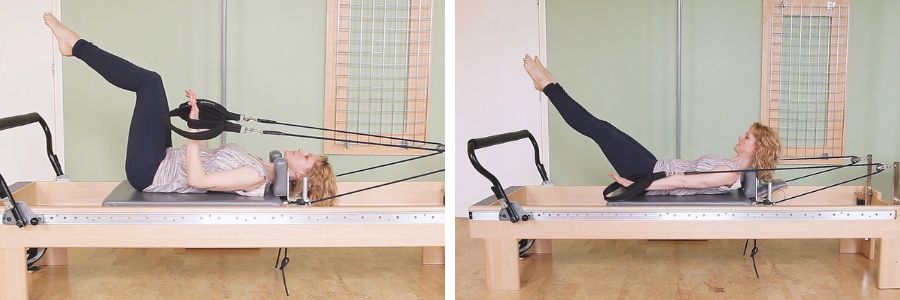
Suddenly, several joints are working simultaneously:
- The head, neck, and shoulders curl into flexion.
- The knees straighten and bend.
- The hips abduct and adduct.
- The trunk is stabilizing.
Whew.
That's a lot more information for the nervous system to organize.
As the number of moving joints increases, so does the challenge. Students must coordinate timing, maintain control, and divide their attention among multiple tasks.
2. Are the Levers Short or Long?
Lever length dramatically changes the difficulty of an exercise.
A shorter lever decreases the demand placed on the body. A longer lever increases it.
Consider Toe Taps.
With the knees bent, the hips and abdominal system are challenged, but the load is relatively moderate because the legs remain in a shortened position.
Now think about Double Straight Leg Stretch.
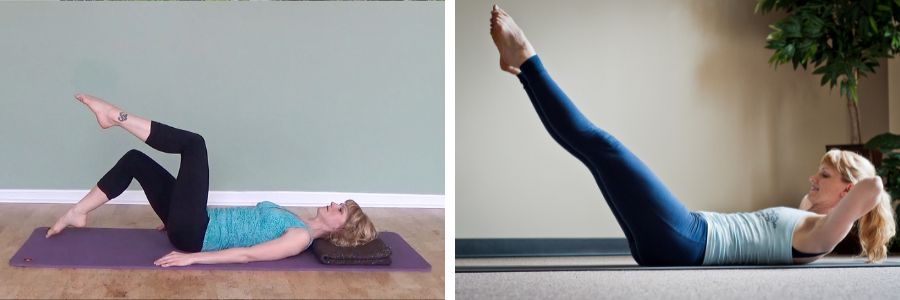
The same regions of the body—the hip joints and the muscles responsible for lumbopelvic stability—suddenly have to manage much greater forces because the legs are extended into long levers. Also, both legs moving at once places a higher load on your trunk stabilizers than moving one leg at a time.
No wonder it feels harder.
The beauty of understanding this principle is that it immediately gives you modification options.
Want to make Double Straight Leg Stretch more accessible?
Simply bend the knees and perform the lowering and lifting pattern with shorter levers.
The exercise changes, but the intention remains.
3. Is the Choreography Simple or Complex?
Sometimes the physical challenge isn't the hardest part.
Sometimes it's remembering what comes next.
Coordination is a perfect example.
So are Short Spine, the Rowing Series, and Seated Push Through.
Can you remember learning them for the first time?
You were probably so focused on remembering the sequence that you barely had any mental bandwidth left to notice how your body was moving.
Complex choreography increases cognitive demand. Students must process instructions, anticipate transitions, and organize multiple actions in the correct order.
Even strong, experienced movers can feel like beginners when the choreography becomes unfamiliar.
4. How Many Directions of Movement Are Involved?
Movement becomes more challenging when it occurs in multiple planes.
Take Single Leg Stretch.
Most of the action occurs in the sagittal plane:
- Thoracic flexion
- Hip flexion
- Knee flexion
Now compare that to Criss Cross.
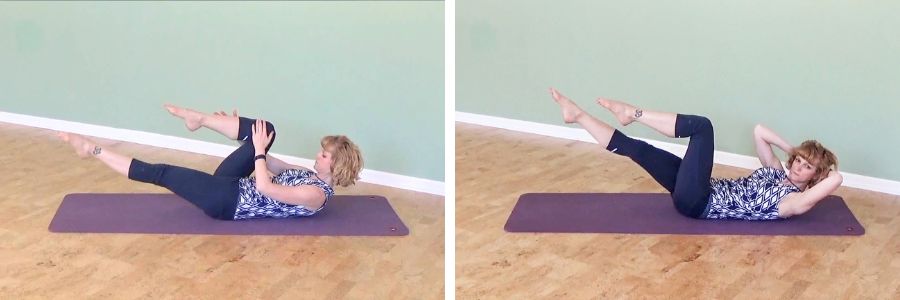
Like Single Leg Stretch, it includes movement in the sagittal plane. But it also introduces rotation of the upper torso, adding the transverse plane to the equation.
That additional movement direction requires greater coordination, spatial awareness, and control.
The more planes of movement involved, the more information the body has to manage.
Beginner for Whom?
Perhaps the most important thing to remember is this:
Exercise levels describe the movement, not the person.
An exercise that feels introductory to one student may be highly challenging for another.
A former dancer may thrive in complex choreography but struggle with upper-body strength.
A weightlifter may excel when force production is required but become frustrated by rotational coordination or filexibility exercises.
A client recovering from an injury may need a very different entry point than an athletic twenty-year-old.
This is why teaching Pilates is both an art and a science.
The labels "beginner," "intermediate," and "advanced" are useful guidelines—but they should never replace clinical reasoning, observation, and professional judgment.
Learn the Rules—Then Use Them Wisely
When you're new to teaching, exercise classifications provide confidence and structure. They help you build classes and avoid progressing students too quickly.
Over time, however, you'll begin to see the patterns underneath those labels.
You'll recognize that you can make an exercise easier by shortening the levers, simplifying the choreography, reducing the number of moving joints, or staying within a single plane of motion.
Likewise, you can increase challenge by doing the opposite.
That's when programming becomes less about memorizing lists and more about understanding movement.
And that's when you truly begin teaching rather than simply following a repertoire.
To make this process easier, we've created a downloadable PDF that organizes the Pilates repertoire by beginner, intermediate, and advanced levels. Use them as a guide, a teaching tool, and a starting point—but remember that the real skill lies in knowing when to adapt the rules to meet the person in front of you.
This PDF is part of our Pilates Teacher Toolbox. Access it here.